
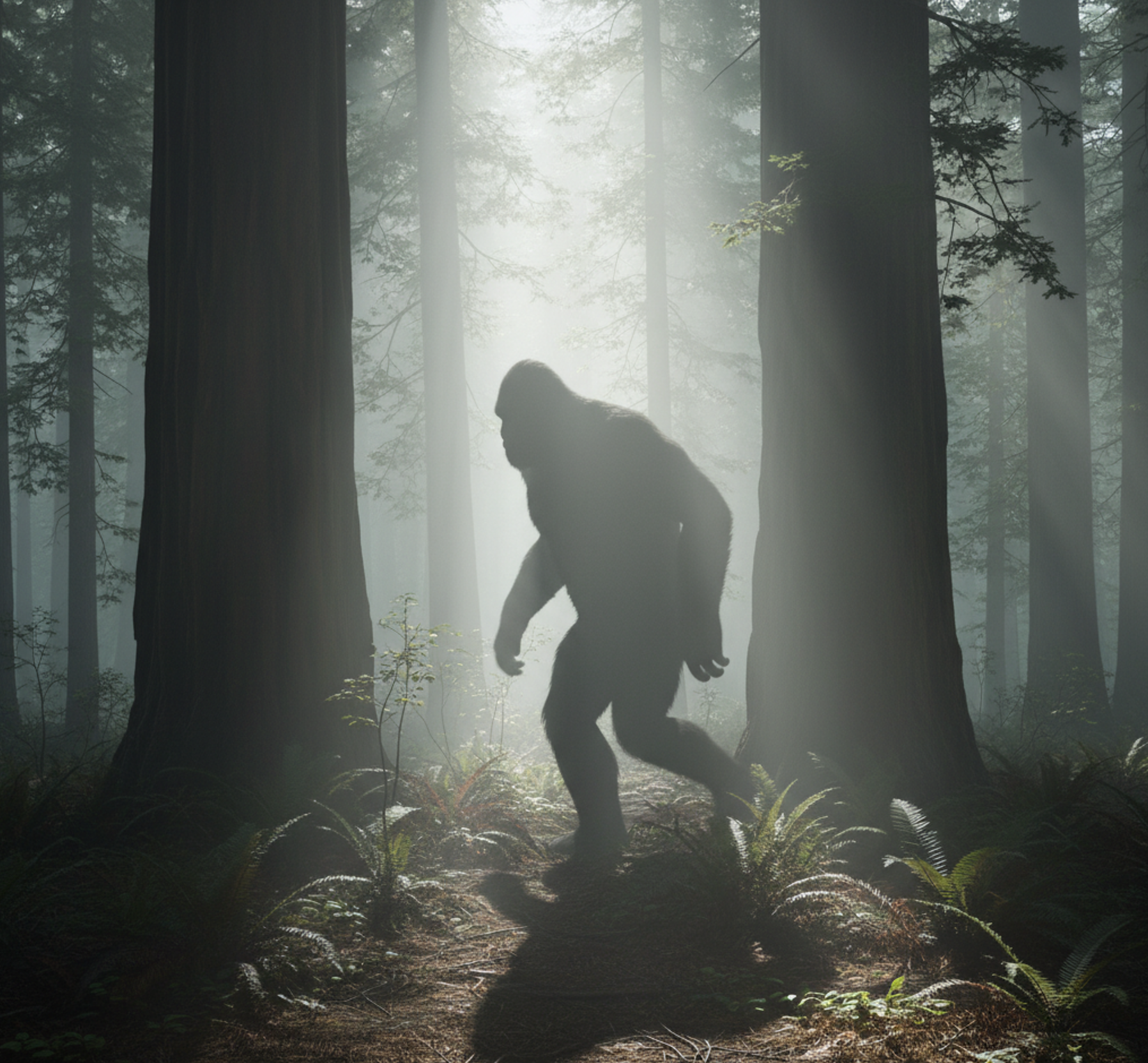
The Patterson–Gimlin Film: A Figure That Refuses to Fade
Some footage ages. Some footage decays. And some footage refuses to settle into the past, as if the moment captured on film is still unfolding somewhere just out of reach. The Patterson-Gimlin film belongs to that last category — a 59‑second fragment recorded in 1967 that continues to resist closure.
It is not the clarity of the image that keeps it alive. It is the tension inside it — the sense that something unscripted, unplanned, and deeply inconvenient walked into the frame and left a mark that decades of analysis have not erased.
This is not a story about a monster. It is a story about a moment that refuses to behave.
A Creek Bed in Northern California
The setting is unremarkable: a stretch of Bluff Creek in Northern California, surrounded by dense forest and steep terrain. Roger Patterson and Bob Gimlin were on horseback, following tracks they believed belonged to a large, unknown primate. The day was quiet, the creek low, the air sharp with the scent of pine.
Then the horses reacted.
They didn’t spook at a shadow or a sound. They reacted the way animals do when something unfamiliar enters their space — something large, something alive, something that does not fit the usual patterns of the forest.
Patterson fell, grabbed his camera, and ran.
What he captured has been examined frame by frame for more than half a century.
The Figure in Motion
The figure in the film does not behave like a costume. It does not move like a man trying to imitate an ape. It moves with a weight and fluidity that feels uncomfortably real — a stride that is long, deliberate, and biomechanically unusual.
The head turns. The arms swing with a reach longer than human proportion. The torso shifts with mass, not padding.
And then there is the moment — the one that has been replayed endlessly — when the figure looks back over its shoulder. Not startled. Not panicked. Just aware.
It is the kind of glance an animal gives when it recognizes it is being watched.
A Film That Should Have Faded
By all logic, the Patterson–Gimlin film should have disappeared into the archives of fringe history. It was shot on a handheld camera, stabilized only by Patterson’s determination. The footage is shaky, grainy, and imperfect.
But it didn’t fade.
Instead, it became one of the most analyzed pieces of film in existence. Scientists, animators, costume designers, primatologists, skeptics, and believers have all taken their turn at dissecting it.
And the deeper they look, the stranger it becomes.
The Anatomy Problem
One of the most persistent questions is anatomical: If the figure is a person in a suit, why does the anatomy behave like something else?
Analysts point to:
- the muscle movement visible beneath the fur
- the non‑human limb proportions
- the rotation of the hips
- the weight distribution in the stride
- the lack of visible seams or folds
- the natural swing of the arms
These are not the features of a costume — especially not one built in 1967, long before modern prosthetics and animatronics.
Skeptics argue that clever staging or a skilled performer could explain the movement. But no one has ever reproduced it convincingly.
Not once. Not in 50+ years.
The Human Element
Patterson and Gimlin were not filmmakers. They were not special‑effects artists. They were not men with the resources to create a groundbreaking hoax. Their story has remained consistent for decades, even under pressure, scrutiny, and the weight of public skepticism.
Gimlin, especially, has maintained a quiet, steady account of the event — not embellished, not dramatized, simply told as he remembers it.
If it was a hoax, it was executed with a level of precision and foresight that seems wildly out of character for two men on horseback in the woods.
Theories That Refuse to Settle
1. A Man in a Suit
The simplest explanation — and the one skeptics default to. But it struggles under the weight of the film’s anatomical details.
2. A Misidentified Animal
Some suggest a bear or other large mammal. But the proportions, gait, and posture do not match any known species.
3. An Unknown Primate
A possibility that aligns with the figure’s movement and build — but raises questions about how such a creature could remain undocumented.
4. A Genuine Encounter with Something Unclassified
The most controversial theory, but also the one that fits the footage without forcing it into a predetermined shape.
None of these theories fully resolve the film. Each explains something, but not everything.
Why the Film Endures
The Patterson–Gimlin film persists because it sits in a narrow space between the explainable and the impossible. It is too detailed to dismiss, too ambiguous to confirm, and too strange to ignore.
It is a reminder that the world is not fully mapped — that there are still edges where the familiar gives way to something else.
The figure in the film does not ask to be believed. It simply walks, turns, and disappears into the trees, leaving behind a question that has not been answered.
Not in 1967. Not now. Maybe not ever.
Conclusion: A Moment That Won’t Resolve
The Patterson–Gimlin film is not evidence in the traditional sense. It is not proof. It is not a conclusion.
It is a moment — a brief, unpolished fragment of reality that refuses to align with what should be possible.
And that is why it endures.
Because some moments are not meant to resolve. Some moments exist to remind us that the world is larger, stranger, and more layered than we assume.
And sometimes, something walks through a clearing and leaves a question behind.