
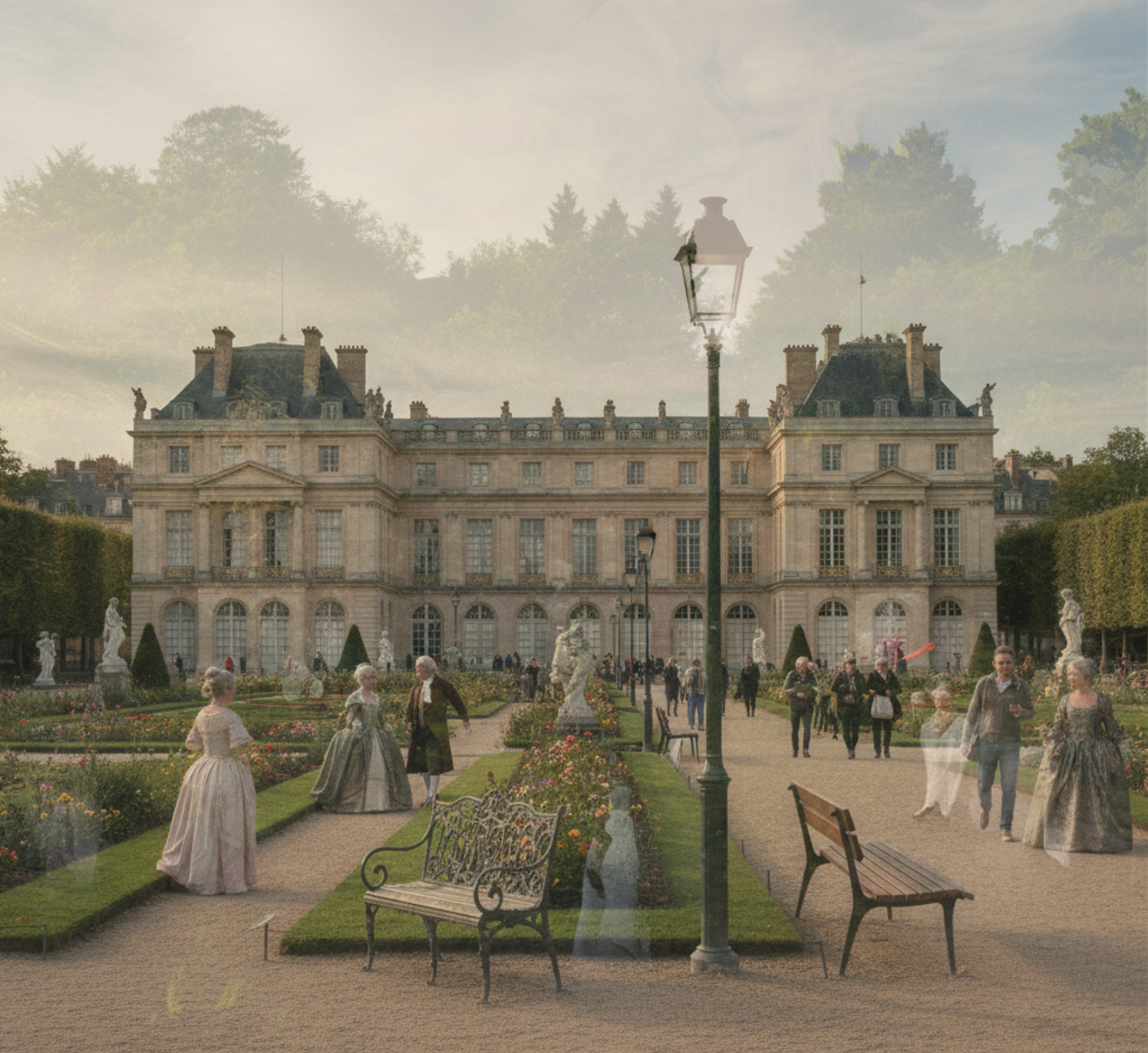
The Moberly-Jourdain Time Slip: A Moment Out of Time
Some events refuse to settle into the past. They linger, not as folklore or exaggeration, but as something quieter — a disturbance in the ordinary rhythm of reality. The Moberly-Jourdain
time slip incident is one of those moments. It is not loud, not cinematic, not wrapped in the usual theatrics of the paranormal. Instead, it is unsettling precisely because of its restraint. Two educated women, walking through a garden, stepped into something that should not have been there.
What happened on that August afternoon in 1901 has been debated for more than a century. But the deeper one looks, the more the event resists simplification. It is a story that sits between history and perception, between memory and anomaly — a story that feels less like an encounter and more like a brief fracture in time.
A Walk Through the Gardens
Charlotte Anne Moberly and Eleanor Jourdain were not thrill‑seekers, mystics, or storytellers. They were academics — disciplined, structured, and grounded in the intellectual culture of their era. Their visit to the Petit Trianon at Versailles was meant to be a simple afternoon excursion, a quiet walk through a historic estate.
But the gardens did not feel right.
The air seemed heavy, muted. The path ahead looked unfamiliar, as if the landscape had shifted into an older arrangement. The women described a stillness that did not match the summer day — a sense that the world around them had thinned, leaving only a narrow corridor of reality.
They continued walking.
Figures Out of Place
The first figure they encountered was a man in a long, old‑fashioned coat and tricorn hat — clothing that belonged to the late 18th century, not 1901. He did not behave like a reenactor or a guide. He simply stood there, watching them with an expression that felt strangely out of time.
More figures appeared. A woman sketching near a garden terrace. Men working near a bridge. All dressed in clothing that should have been confined to paintings and archives.
None of them acknowledged the women.
None of them seemed aware that they were out of place.
And then, as abruptly as it began, the atmosphere shifted. The heaviness lifted. The path returned to its familiar shape. The figures were gone.
The women walked out of the garden in silence.
The Attempt to Explain the Impossible
It took them days to speak about what they had seen. When they finally compared notes, the details aligned with unsettling precision. Their descriptions matched historical records they had not yet read — including the layout of the gardens before later renovations.
The woman sketching near the terrace? Some believe she resembled Marie Antoinette.
The bridge they crossed? It had been removed decades before their visit.
The clothing, the tools, the mannerisms — all consistent with the late 1700s.
Skeptics have offered explanations: misinterpretation, shared delusion, emotional stress, or the influence of romanticized history. But none of these fully account for the accuracy of the details the women described — details they should not have known.
A Moment Suspended Between Eras
The Moberly–Jourdain incident is often labeled a “time slip,” but the term feels too neat for something so elusive. If it was a slip, it was not a journey. The women did not travel. They did not vanish. They did not interact with the past.
Instead, the past seemed to surface around them — briefly, silently, like a reflection rising through still water.
This is what makes the event so compelling. It does not behave like a haunting, nor like a hallucination. It behaves like a momentary overlap, a thin place where two eras pressed against each other.
Not a portal. Not a vision. Just a moment where time lost its footing.
Theories That Try to Hold the Edges Together
1. A Residual Imprint
Some researchers suggest the gardens may hold a kind of environmental memory — a lingering imprint of intense historical moments. The women may have walked through a place where the past was unusually “loud.”
2. A Perceptual Distortion
Others argue that the women entered a psychological state where imagination and reality blurred. But this does not explain the historically accurate details they later verified.
3. A Shared Anomalous Experience
A more modern interpretation suggests that consciousness itself may occasionally slip into non‑ordinary perception — not hallucination, but a temporary widening of awareness.
4. A Genuine Temporal Overlap
The most literal theory: For a few minutes, the boundary between centuries weakened, and the women saw the past as it was.
None of these theories fully resolve the event. Each explains something, but not everything.
Why the Story Endures
The Moberly–Jourdain incident persists because it is not dramatic. It is not embellished. It is not shaped like a legend. It is shaped like a memory — quiet, specific, and stubbornly difficult to dismiss.
It suggests that time may not be a straight line. It suggests that history may not be as distant as it seems. It suggests that the world may hold moments where the past is not gone, only hidden.
And it suggests that sometimes, without warning, the hidden becomes visible.
Conclusion: A Glimpse Through the Veil
More than a century later, the event remains unresolved. Not disproven. Not confirmed. Simply suspended — like the moment itself.
The Moberly–Jourdain time slip is not a story about ghosts or visions. It is a story about perception, memory, and the fragile architecture of time. It is a reminder that the world is older, stranger, and more layered than we allow ourselves to believe.
And sometimes, if the conditions are right, those layers shift.
Just enough for someone to notice.